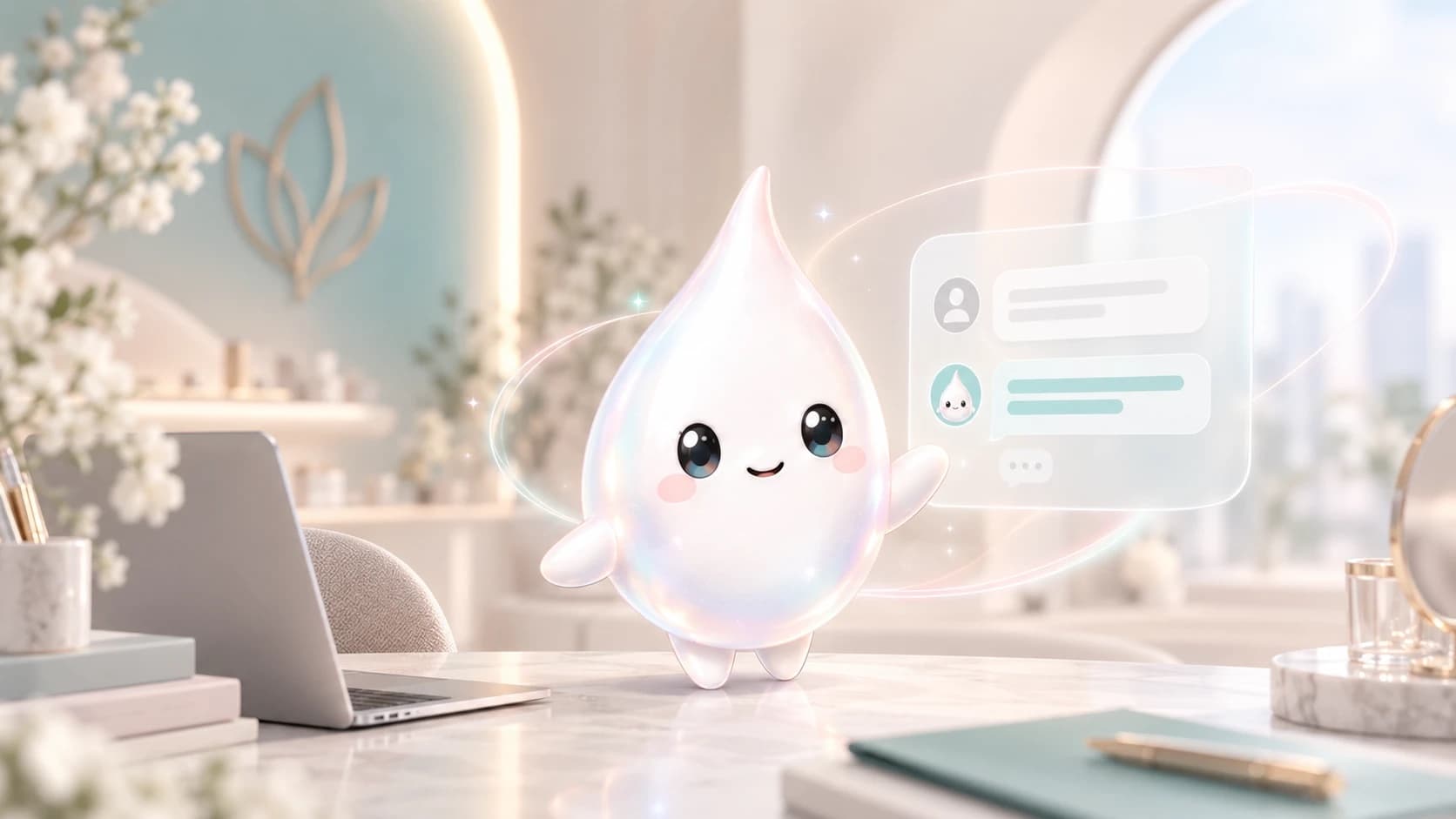
"I want an AI chatbot that helps my admin answer questions about our services correctly."
If you run a business in Thailand today, that sentence is probably the voice in your head. It was ours too. And I want to say this as kindly as I can: you are asking for too little.
Any well-built chatbot with a decent knowledge base can now tell a customer what a treatment costs, how long it takes and how to care for their skin afterwards. That was hard in 2023. In 2026 it is the entry ticket. And when every business clears the same bar, something predictable happens. Every chatbot starts to sound exactly like every other chatbot.
This article is the playbook we used to fix that for Aira, our own AI assistant. It borrows from psychology rather than marketing decks, and you can run it on any chatbot, in any industry, this week.
What an AI chatbot personality actually is
An AI chatbot personality is the consistent character behind the answers: who the chatbot is, how it speaks, and how it behaves when a conversation gets emotional. It is separate from the knowledge base. The knowledge base decides what the chatbot says. The personality decides how it says it, and that "how" is what a customer remembers.
The playbook in five steps
- Choose archetypes from Jung's twelve. Run it as a workshop with the people who talk to customers. Keep four or fewer, rank one as primary.
- Score the four dimensions of voice (formality, humour, respect, enthusiasm) from 0 to 10, and write an example sentence for every point so the team chooses words, not numbers.
- Set situational overrides where it matters, such as more sincerity when a customer is upset.
- Generate the system prompt from those choices, then tune it against real conversations.
- Design the visual character to match the voice, and put it everywhere customers meet the brand.
The rest of this post walks through each step with what we chose for Aira and why.
Why every chatbot sounds the same
We build AI sales assistants for aesthetic clinics. When we started, the win was simple: correct answers, at 2am, in seconds. Then we started reading conversations at scale, across many clinics, and a pattern emerged. The replies were right. They were also long, complete, polite and interchangeable. Swap the clinic name and nobody would notice.
That matters, because a customer chatting with a clinic is rarely just collecting facts. They are being advised. Advice needs a way of speaking. It needs softness in some places and directness in others. It needs a person behind it.
Think about your own buying behaviour. I have chosen Brand A over Brand B with identical products, purely because of how Brand A talked to me. If a chatbot is going to greet every lead your business gets, it should carry your personality, not a default one.
Before and after: the same question, twice
Before the framework, I opened LINE and told Aira I was getting married and wanted my skin ready for the day. She recommended Pico Laser, sent the service image, quoted the single-session and five-session prices, asked when the wedding was, and noted a session takes 15 to 30 minutes with little downtime.
Every fact correct. It read like a brochure with a chat bubble around it.
After the framework, same question, same knowledge base. Different person answering.
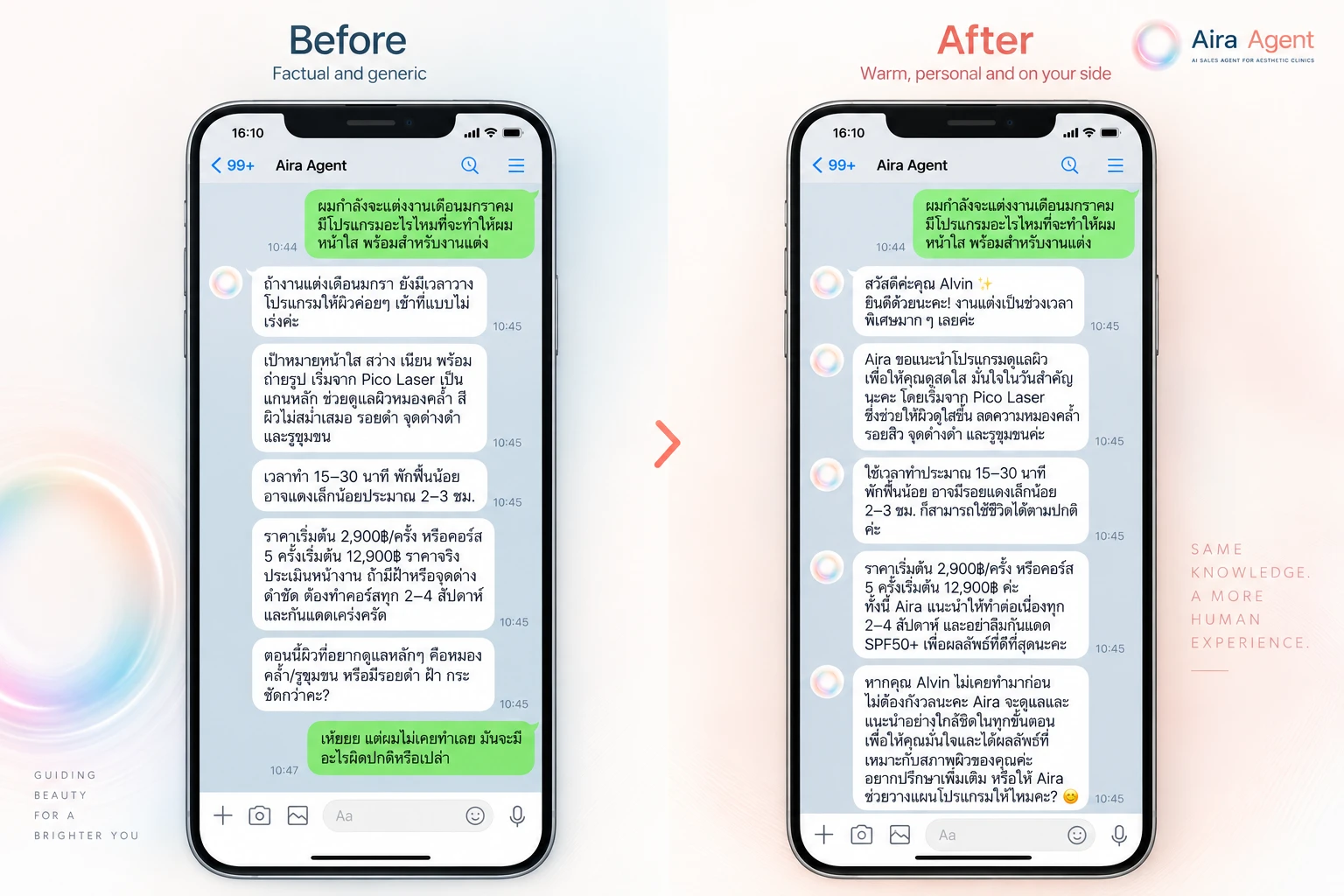
Same knowledge base, same question. Left: before the framework. Right: after.
The difference is not the data. It is everything around the data. The hard part is describing "everything around the data" precisely enough that a model can follow it. Two frameworks do that job.
Framework 1: Jung's 12 archetypes
When I first tried to design a personality, I stared at a blank page. "What kind of person should our chatbot be?" has no structure. There are too many kinds of people.
Psychologists solved this long ago. Carl Jung described twelve archetypes: character patterns every human recognises because every human has lived some of them. Brands have quietly used them for decades, which is why the wheel below has a logo in every slice.
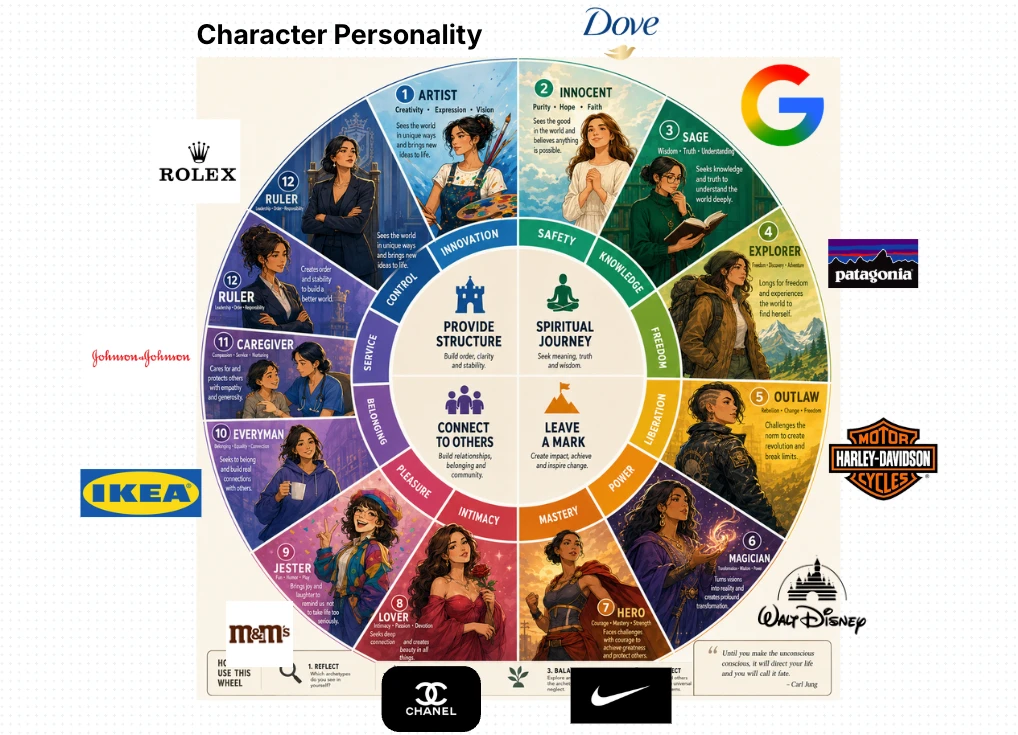
The character personality wheel: twelve archetypes in four groups, and a brand that owns each one.
| # | Archetype | Core drive | A brand that owns it |
|---|---|---|---|
| 1 | Artist | Creativity, expression, vision | Apple |
| 2 | Innocent | Purity, hope, faith | Dove |
| 3 | Sage | Wisdom, truth, understanding | |
| 4 | Explorer | Freedom, discovery, adventure | Patagonia |
| 5 | Outlaw | Rebellion, change, freedom | Harley-Davidson |
| 6 | Magician | Transformation, vision, power | Walt Disney |
| 7 | Hero | Courage, mastery, strength | Nike |
| 8 | Lover | Passion, intimacy, devotion | Chanel |
| 9 | Jester | Fun, humour, play | M&M's |
| 10 | Everyman | Belonging, equality, connection | IKEA |
| 11 | Caregiver | Compassion, service, nurturing | Johnson & Johnson |
| 12 | Ruler | Leadership, order, responsibility | Rolex |
Once you see it, you cannot unsee it. Google markets like a Sage: technical, detailed, a document for everything. Nike has told the Hero's journey for decades, from Michael Jordan to Eliud Kipchoge. Walk into a Nike store, then walk to a Chanel counter, and watch how differently the staff carry themselves and tell their story. That is an archetype expressed through people. We want it expressed through a chatbot.
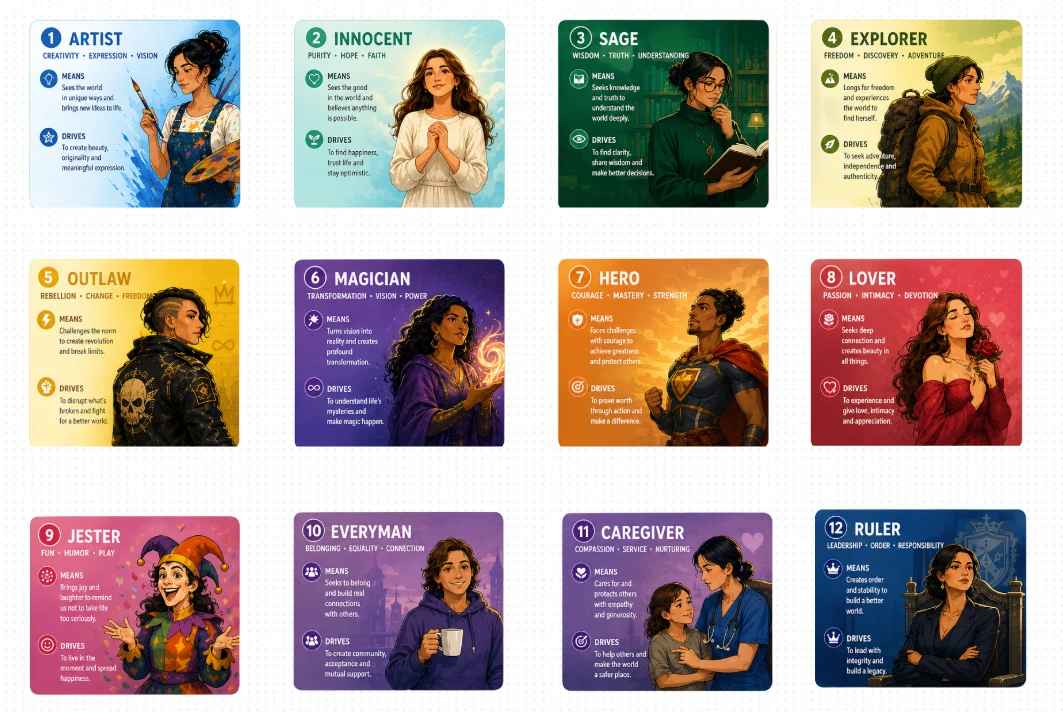
The twelve archetype cards. Each one names what the character means and what drives it.
Three rules for choosing
Run it as a workshop. When we do this with a clinic, we do it with their customer service team. They already have patterns in how they reply, and when they see the wheel they recognise themselves in it. That recognition is what you are capturing.
Four or fewer. Our first pass produced six. Above four, the character blurs and the system prompt starts contradicting itself.
Rank them. One primary, one or two secondary. The primary wins whenever there is a conflict. Tell a model "be all of these equally" and it has no way to decide in the moment, so it hedges, and hedging is what generic sounds like.
What we chose for Aira, and why
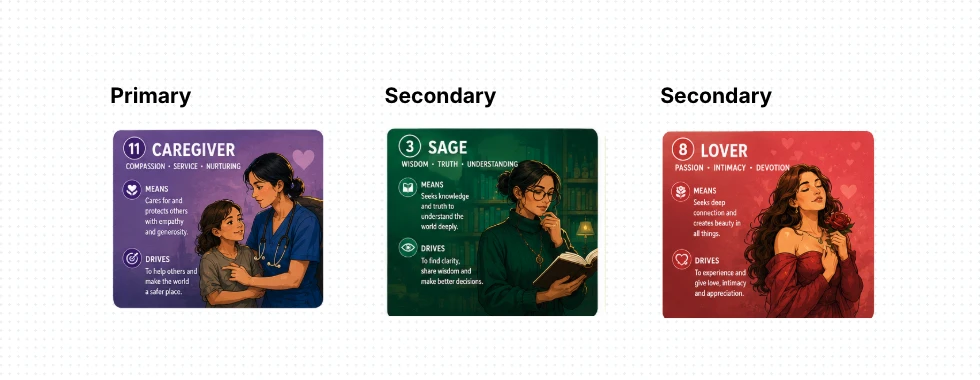
Aira's three archetypes, ranked. Caregiver wins every conflict.
Primary: Caregiver. People chatting with a clinic are often nervous about a treatment. Care comes first, always.
Secondary: Sage. Customers ask real medical questions and deserve clear, knowledgeable answers.
Secondary: Lover. This is a beauty business. Warmth, appreciation and an eye for beauty belong in the voice.
Left out on purpose: Jester. Humour builds closeness fast, and a customer who laughs with Aira feels like they know her. But a joke at the wrong moment, to someone who has never met you, can end the relationship instantly, and we cannot yet guarantee a chatbot's timing or that its sense of humour matches the person it is serving. Jester is parked for a later phase, once trust is established. Deciding what to leave out is as much a part of the playbook as what you put in.
Framework 2: the four dimensions of voice
Archetypes give you the skeleton. They are still too broad to control how a single reply reads. For that, every human voice sits somewhere on four spectrums, each scored 0 to 10:
- Formality: casual to formal
- Humour: serious to playful
- Respect: irreverent to deferential
- Enthusiasm: restrained to energetic
Nobody can picture what "a 6" sounds like, so we wrote an example sentence for every point on every scale, all answering the same situation: a customer with an account issue. Now the team is choosing a sentence, not a number.
You can produce your own set in a minute: screenshot the scale, give it to any AI model, and ask for the 0 to 10 versions in your working language and your industry.
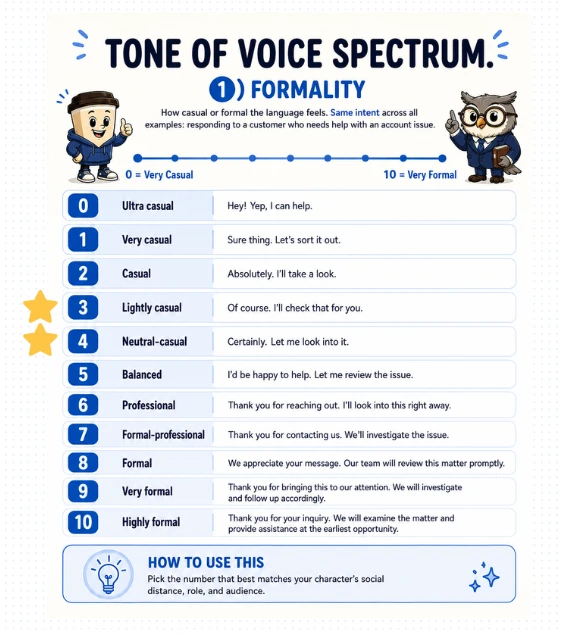
Formality. Aira: 3 to 4, lightly casual to neutral. Mark and I agreed on this fast. Too formal and Aira reads like a corporate email. Too casual and she is acting like your close friend on the first message, which is unnatural: nobody is best friends with someone they met ten seconds ago. Your number will differ. A law firm serving corporate clients belongs near 8 or 9. A streetwear brand talking to Gen Z belongs at 1 or 2.
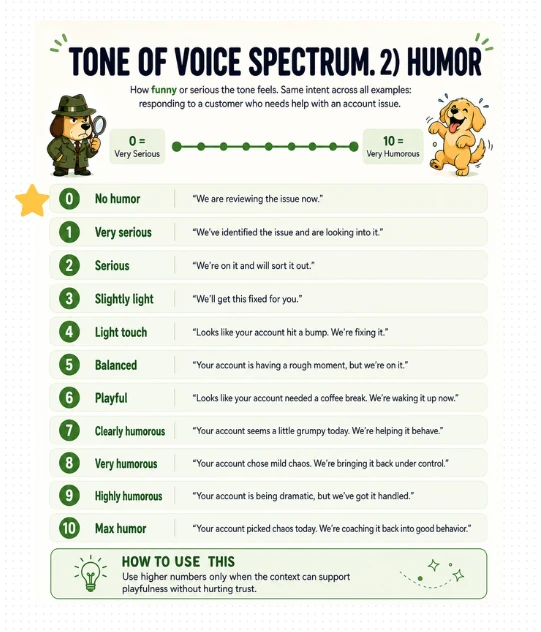
Humour. Aira: 0. Same reasoning as cutting Jester. "We're reviewing the issue now" is all we want. Go higher only when your context can carry playfulness without costing trust.
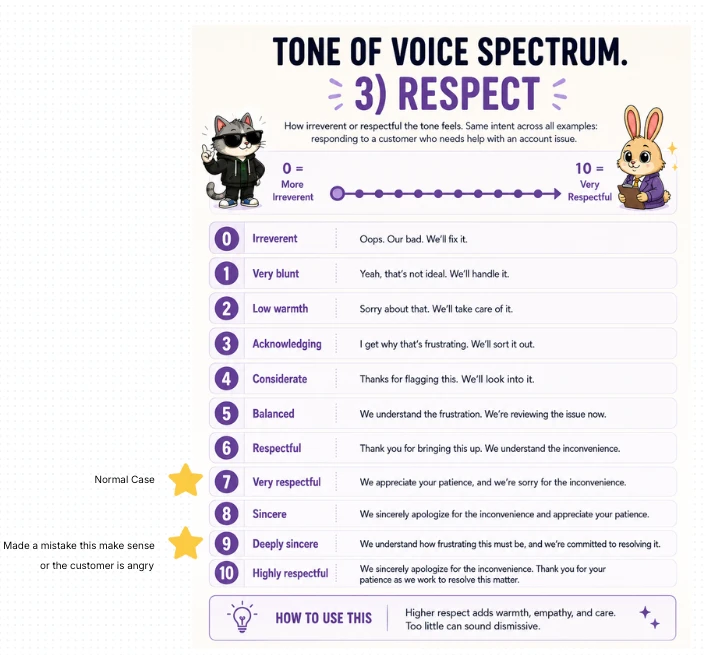
Respect. Aira: 7 by default, 9 when something has gone wrong. Picture the ends: zero is the laid-back bro with all the swagger; ten is the Japanese shop assistant who walks you to the lift and bows as the doors close. Mark wanted Deeply Sincere (9) everywhere. I wanted Very Respectful (7). When we tested 9 everywhere, every reply became a formal apology, even when nothing had happened, and the messages got long and stiff. So we split it by situation. Normal conversation sits at 7. When Aira has made a mistake or the customer is upset, she moves to 9. In a clinic this is not hypothetical; customers do come back unhappy with a result, and the last thing they need is a chatbot adding to the frustration.
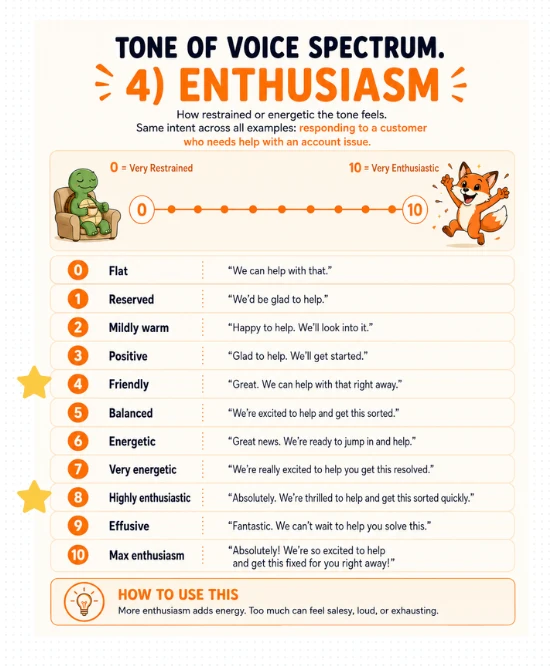
Enthusiasm. Aira: 4, with a plan to grow. This is the one we argued about, and both stars are on the chart because neither of us fully backed down. I wanted 8: a customer is starting a journey with us, and I want them a little excited about it. Mark wanted 4: most people chatting with a clinic are new, and when a stranger greets you with huge energy it feels off. You wonder what they want from you.
Mark's argument won the first conversation, and it also produced the best idea of the workshop, now on our roadmap: enthusiasm should grow with the relationship. First chat, friendly and measured. Fourth chat, or a returning customer booking a second treatment, Aira should visibly warm up. "You're back! How did it go?"
This is how good human service already works. I once shopped for an iPhone and bought from the salesperson who was most direct with me; he told me plainly which insurance to skip. Other shops matched his price, but I went back to him. The first visit, he was neutral. The second, he saw my face and said, "You're back. Ready to buy today? The promotion ends soon." The dynamic changed the moment he recognised me, and it felt good rather than pushy. Or think of your coffee shop: "What can I get you?" on day one, "Hot latte as usual?" on day thirty. Nobody designed that. It is what warmth looks like once it is earned, and we want Aira to do it on purpose.
Turning the choices into a system prompt
You do not have to write this by hand. Give the model your decisions and ask it to structure the priorities. Here is the template we use; replace the bracketed values with yours.
You are [NAME], the AI assistant for [BRAND], a [INDUSTRY] business in [MARKET].

PERSONALITY (Jungian archetypes, in priority order)
- Primary: [ARCHETYPE]. When two instincts conflict, this one wins.
- Secondary: [ARCHETYPE], [ARCHETYPE].
- Explicitly not: [ARCHETYPE], because [REASON].

VOICE (0 = low, 10 = high)
- Formality: [N]. Example of the target register: "[SENTENCE]"
- Humour: [N]. Example: "[SENTENCE]"
- Respect: [N] by default. Example: "[SENTENCE]"
- Enthusiasm: [N]. Example: "[SENTENCE]"

SITUATIONAL OVERRIDES
- If the customer is upset or we made a mistake: Respect moves to [N], acknowledge before explaining, keep it short.
- If the customer is returning: Enthusiasm may rise to [N].

STYLE
- Answer in the customer's language. Keep replies short; advise, do not recite.
- Never invent facts outside the knowledge base.
Write the example sentences in the language the chatbot actually works in. Ours were in English for an international client first; for a Thai audience, generate them in Thai. Then ship it, read real conversations, and tune. You will not get it right the first time, but you now have an anchor to tune towards instead of a vague wish that the bot "sounded nicer."
Step 5: give the character a face
The character does not live only inside the chat window. It goes on the website, in social posts and in the LINE rich menu, so customers see Aira and know who they are about to talk to. Our earlier visual was warm but high-energy, and after the workshop it no longer matched the voice. The new Aira is a little slimmer, more clearly the water droplet she is built on, still warm in the face, but calmer and more composed: Caregiver plus Sage, drawn.
Two notes. First, this is a brand mascot, and with today's video models you can put it to work explaining treatments or fronting a promotion. Second, it is not final and should not be. AIS's น้องอุ่นใจ has visibly evolved over the years. A chatbot is the one place customers fully understand they are talking to an AI, so a clearly non-human character is honest as well as memorable.
The point
None of this needs a new model or a bigger budget. It needs you to decide who your chatbot is before you ask it to speak for you. Accurate answers get you into the game. Personality is how a customer choosing between two businesses with the same product and the same price ends up choosing you.
If you would like us to run this workshop with your clinic's team, get in touch. Aira is an AI sales assistant for aesthetic clinics in Thailand, answering on LINE around the clock with your clinic's knowledge and, now, your clinic's personality.
Frequently asked questions
What is an AI chatbot personality, and how is it different from a knowledge base?
The knowledge base is what the chatbot knows: services, prices, policies. The personality is who the chatbot is: its archetypes, its tone on each dimension of voice, and how it behaves when a customer is upset. Two chatbots can share a knowledge base and feel like completely different people.
How many archetypes should a chatbot have?
Four or fewer, ranked. One primary that wins conflicts, and one or two secondaries. In our experience, more than four blurs the character and produces a system prompt that contradicts itself.
Should a chatbot be funny?
Usually not at launch. Humour builds closeness quickly but a badly timed joke to a stranger can end the relationship, and you cannot yet guarantee a model's timing. Start at zero, and consider adding light humour once the chatbot has earned trust and you have read enough real conversations to know what lands.
Can a chatbot's tone change depending on the situation?
Yes, and it should. Set a default score for each dimension of voice, then define overrides: for example, Respect at 7 normally but 9 when the customer is unhappy, or Enthusiasm rising for returning customers. These belong in the system prompt as explicit rules.
Do I need a custom model or fine-tuning to give a chatbot a personality?
No. Everything in this playbook is done through the system prompt: ranked archetypes, scored voice dimensions with example sentences, and situational overrides. The work is in the decisions, not the technology.
Ready to see Aira in action?
Try Aira on LINE — or meet the team in a 30-minute demo.